Change Your Approach to Running Ads, Maximize ROI

.webp)
You know ads are a powerful tool to increase visibility and grow your business online. But what do you do if you're wasting money and not getting a positive ROI?
Today, we'll use the clinical method to help diagnose and treat your ad problem so you can stop throwing your hard-earned money away and start using it to actually compound your revenue.
This will not be a technical breakdown of how to set up or analyze ads, but instead an overarching strategy and approach to running effective advertisements.
Over the past five years, I've run my fair share of ads for myself and for service-based businesses in health care and home services.
I've learned a lot along the way, and I'll be sharing that with you here.
So let's get into it.
Common Symptoms Your Ads Aren’t Working
Recently, I worked with a functional medicine doctor. We'll call her Dr. Marty.
She told me she spent $40,000 on Google and social media ads in one year and got nothing out of it. I couldn't believe it. My heart honestly sank.
Clearly, she ignored the signs and symptoms, and the situation got out of control.
So let's identify what you need to look out for when you're running your own ads so you don't end up like Dr. Marty.
1.) You’re Spending More Than You’re Making
This one is obvious, but if you're spending more than you're ultimately making, you've got a problem that isn't just going to resolve itself.
In Dr. Marty's case, she thought if she threw more money at the problem, it would eventually pay off.
And that leads to the next symptom.
2.) You Increase Your Budget With No Improvement
If you increase your budget and still see no improvement, there's clearly something wrong with the ad itself.
Now, I often say ads take time to start working, at least a few months or so.
But as a rule of thumb, you should not increase your budget if you're not even getting positive signals to begin with.
3.) You’re Attracting the Wrong People
Symptom number three is when your ads are "technically" working.
You're getting clicks and maybe even bookings, but you're consistently attracting the wrong people.
Maybe they decide you're not the right fit, or you know they're not a good fit, but you work with them anyway because you don’t want it to feel like a waste of money.
I've been there. This is a symptom that won’t go away unless you do something about it.
4.) When Ads Turn Off, You’re Invisible
The fourth and final common symptom is that when your ads are turned off, you're invisible.
Your calendar is empty.
These are serious signals you do not want to ignore.
The Real Causes Behind Poor Ad ROI
These symptoms are typically due to a few core issues.
1.) You Set the Wrong Goal
The primary reason your ads are a waste is because you set the wrong goal. We've all fallen victim to this.
The allure of running ads is that you can pull out a credit card and instantly get to the top without the time and effort required to earn attention organically.
It feels like a quick fix.
Naturally, we want the ads we're spending money on to lead directly to money in our pockets. But that’s not how it works.
Think about it.
Do you see an ad, click it, view the landing page or video, and immediately decide to buy?
Of course not.
That would be like finding someone on a dating app and deciding to marry them before you even meet them. That’s insane.
In marketing terms, this is the sales funnel.
The conversion phase, also known as the bottom of the funnel, only comes after awareness and consideration. What’s happening is you’re trying to push people straight into conversion before they’ve spent time in the earlier stages.
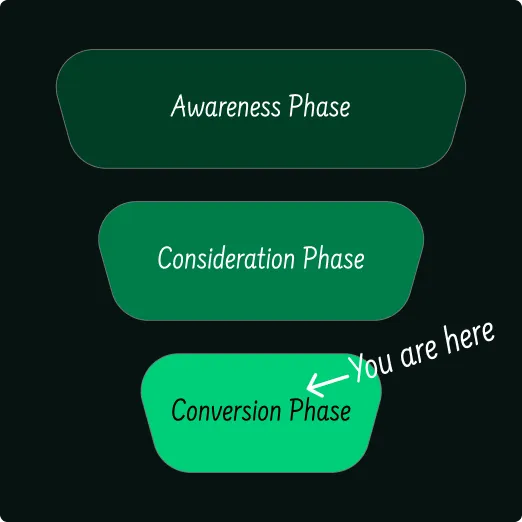
You haven’t even hit the talking stage, and you’re already thinking about marriage.
So they hit your landing page, feel like you're moving way too fast, and they bounce. Now, you’ve spent your money and didn’t even get their contact information.
2.) Your Ad Copy Doesn’t Match the Offer
Another cause is misalignment between your ad copy and what you're actually promoting or offering.
When expectations don’t match reality, trust is lost immediately.
3.) You’re Relying on Ads to Do All the Marketing
A third cause is relying entirely on ads to do the heavy lifting.
If someone clicks your ad, likes what they see, and then checks out your business but finds no helpful content, videos, or education, you look more like a scam or gimmick than a serious business.
4.) You Ignore the Problem and Hope It Fixes Itself
The final cause is simply ignoring the issue and letting ads run month after month, hoping something will magically change.
Dr. Marty fell victim to this.
She was getting bad advice and was told the ads just needed more time. After the first thousand dollars, I would have been concerned. Maybe that’s just me.
What to Do Instead to Improve ROI
Considering everything so far, let’s talk about what you can do to actually get a return on your investment.
Stop Running Bottom-of-Funnel Conversion Ads
The first thing I recommend is stopping bottom-of-funnel conversion ads that send people straight to your homepage and hope for the best.
This is not the right way to run ads.
If you're desperate for clients or revenue, these ads will only make things worse. Ads are just one part of your marketing strategy, and they work best when you have both budget and patience.
The most effective ads focus on delayed gratification.
They’re designed to build awareness and interest, not close a sale immediately.
You offer free value to help people understand their problem, and in return, you collect their contact information.
This approach has always been the gold standard for sustainable growth. You're building an audience, a community, and a list.
High-ROI Ad Offers That Actually Work
Quizzes and Assessments
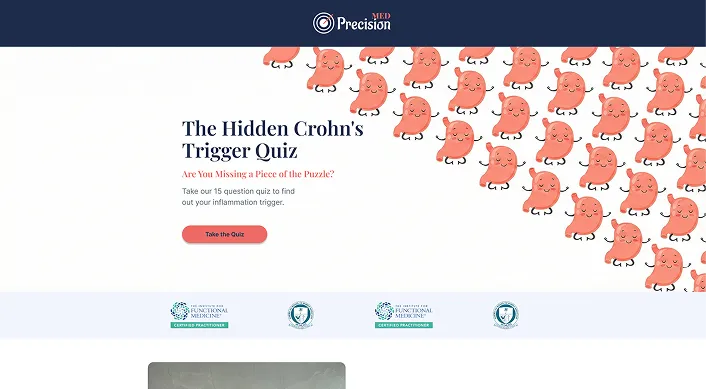
One of my favorite tools is a quiz or assessment. These help people in the awareness phase identify a potential cause of their problem.
For example, a functional medicine doctor specializing in Crohn’s disease might use:
“The Hidden Crohn’s Trigger. Are You Missing a Piece of the Puzzle? Take our 15-question quiz to find your inflammation trigger.”
Blueprints and Roadmaps
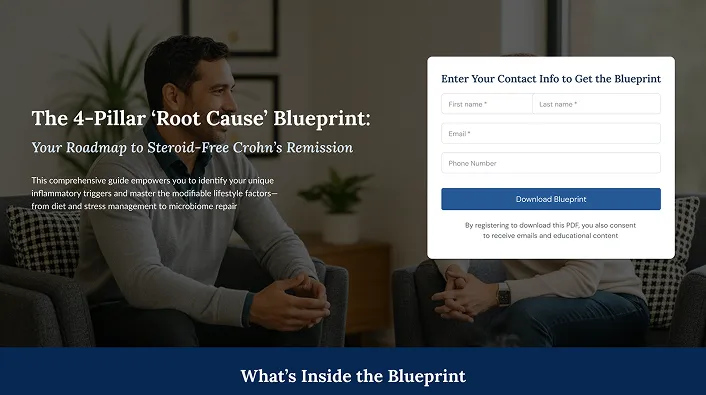
Another great option is a blueprint or roadmap that lays out the process for overcoming a problem.
For example:
“The Four-Pillar Root Cause Blueprint. Your Roadmap to Steroid-Free Crohn’s Remission.”
Masterclasses or Mini-Courses
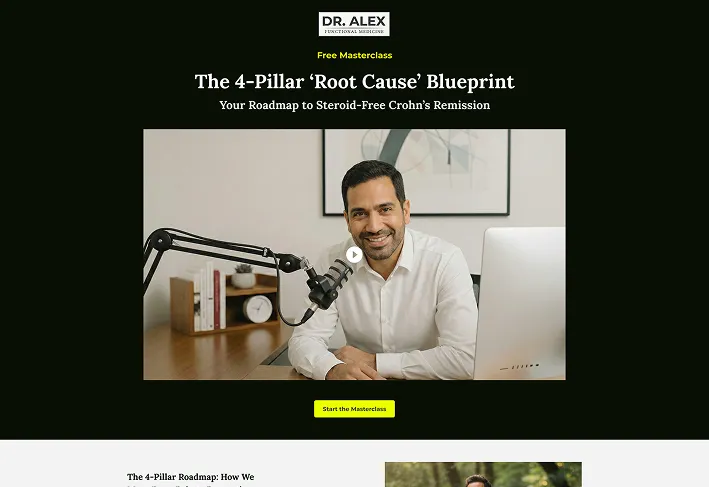
You can also create a masterclass or mini-course. This is essentially the video version of the blueprint and is excellent for building trust because people get to connect with you and your personality.
Community Groups
Community groups like Facebook groups, WhatsApp groups, or Skool communities can also be powerful.
For example:
“Tired of fighting Crohn’s alone? Join our Facebook group for patients working toward steroid-free remission.”
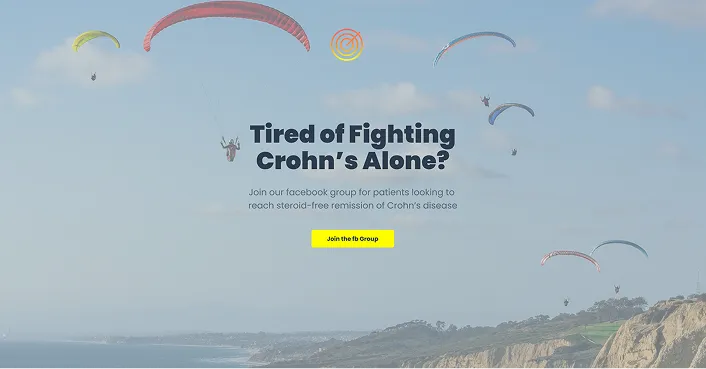
Regardless of which option you choose, it should be free and gated behind an email opt-in.
Keep Your Landing Page Focused
Your landing page should feature only one free offer and one call to action. Multiple buttons like take the quiz, book a call, or learn more create confusion. You want one clear action.
Your ad should promote that single offer directly. Avoid generic keyword-based copy. Instead of saying something like “Crohn’s disease treatment for moderate to severe cases,” say:
“Take our Crohn’s disease treatment quiz to discover your hidden trigger.”
Now they’ve engaged with your ad, received value, and are closer to trusting you. If they book a consultation immediately, that’s great. If not, you still have their contact information and can continue nurturing them with content.
Content Is Still Essential
Content, especially educational content, is essential. It’s one of the highest-leverage assets your business can have. I recently made a video outlining a simple content strategy, so check that out if you haven’t already.
If you follow this treatment protocol, you’ll be on the right track to improving your ROI.
When Direct Conversion Ads Can Work
As a quick aside, there is a way to effectively run ads that send people straight to conversion. One example is an active ad from mgclinic.com. It leans heavily on Dr. Dani’s personal story, from IBD patient to gut surgeon, and establishes credibility immediately. The page is filled with video and written testimonials from real patients.
If you can do something similar for your business, you may be able to get bookings directly from ads. But if that doesn’t work, fall back on ads that provide free value first.
A Simple 4-Week Roadmap to Better Ad Performance
You can dramatically improve ad performance in as little as four weeks.
- Day one, pause your ads and stop the bleeding.
- Weeks one through three, identify a core problem you solve and build your campaign around it. Create the free resource, write the copy, and build the landing page.
- Week four, set your budget, define your analysis timeline, and turn the ads back on.
Remember, ads are only one part of your marketing strategy. Without organic content, they’re far less effective. There’s a reason people say content is king.
But do you need to post every day, be on every platform, or turn into a slimy marketer? In this post, I break down a simple content strategy that avoids all of that. I’ll see you there.
About the Author
I’m Ryan, a certified health education strategist who’s spent 5+ years working inside the marketing world and realizing how overcomplicated it’s become for medical professionals. My focus is helping clinicians attract patients by teaching, not marketing—using simple, sustainable content systems that build trust and make a real impact. When I’m not creating resources for doctors, you’ll find me sharing practical ways to educate online without the noise, pressure, or burnout.

Related Posts
How This Doctor Doubled His Practice's Revenue in One Year
Building a Brand Is How You Win as an Independent Doctor